
One of the essential things we do to achieve goals, whether personal goals, career aspirations, or financial goals, is creating a structured plan. Setting goals is necessary as they motivate people to succeed, maintain focus, and bring optimism for the future. This article will provide step-by-step guidance on how to organize your goals and create an effective action plan, serving as a valuable resource for building your strategy.
However, how to organize goals effectively is just as important as setting them. Without careful planning, your goals—whether losing weight, growing your own business, or completing a deep cleaning task—can remain unfinished. So, how can you ensure that your goals are realistic, achievable, and aligned with your big picture? The answer lies in creating an action plan.
An action plan is a strategic roadmap that clearly defines all the tasks, daily goals, and milestones needed to accomplish your objectives. It helps track progress, maintain momentum, and stay motivated over time. Whether for a marketing team, a business project, or personal development, an action plan ensures that the important things get done efficiently.
To put it simply, an action plan is a prerequisite to organizing your goals. Nowadays, businesses are emphasizing more on creating an action plan. For anyone starting a new job or taking on new responsibilities, action plans are essential to tackle daily challenges effectively.
Nowadays, organizations and individuals are realizing the value of action plans in both short-term and long-term planning. They are essential for setting goals, creating a to-do list, and allocating time to complete tasks effectively.
Understanding SMART goals
SMART goals are the backbone of effective goal setting and action planning. The SMART framework ensures that your objectives are Specific, Measurable, Achievable, Relevant, and Time-bound. By making your goals specific, you clarify exactly what you want to achieve, which makes it easier to create an action plan with clear steps. Measurable goals allow you to monitor progress and celebrate milestones along the way, keeping your motivation high.
Setting achievable goals means being realistic about your resources and abilities, so you can create a plan that is challenging yet possible. Relevant goals ensure that your efforts are aligned with your personal values and long-term vision, making your progress meaningful. Finally, time-bound goals give you a specific deadline, helping you prioritize tasks and maintain momentum. By understanding and applying the SMART goal framework, you lay the groundwork for an effective action plan that leads to real, lasting success.
5 Types Of Action Plans for Goal Setting

There are several types of action plans. What action plan one adopts depends on the situation they are in. A strategic plan sets the overarching objectives for an organization and serves as a foundational document that guides the creation of specific business action plans. Let’s discover different types of action plans:
1: Business Action Plan for Setting Goals
Businesses often create business action plans on a monthly basis or for the whole week to achieve objectives like revenue growth or expansion. A good plan ensures the marketing team and other departments stay aligned and focused on larger goals. By determining the key challenges of the past year, companies can set a specific deadline for achieving their top goals.
2: Sales Action Plan to Track Tasks in a To-Do List
Sales action plans are related to all revenue generation activities, including identifying and completing each action item to ensure sales goals are met. Sales action plans help in achieving sales growth and goals. A more in-depth part of this plan is monitoring customer relations and how to win new clients.
3: Marketing Action Plan to Develop Habits
Marketing Action Plan is for sales and promotional activities. A marketing action plan ensures that the promotional and marketing strategies are executed as desired. Decision making is crucial here to tackle challenges and stay on track.
Regular practice of your marketing activities, such as consistently reviewing and refining your strategies, is essential for effective execution and ongoing improvement.
4: Project Action Plan
Project action plans break down complex tasks into manageable tasks. Using tools like Google Calendar can help schedule activities and track progress toward larger goals.
5: Personal Development Action Plan
These are the sort of action plans that are created to achieve personal goals. Individuals make them. A fine example of personal development goals could be getting into shape or saving up for a new car or house. Personal development action plans are for personal goals like losing weight, developing habits, or learning new skills. These plans allow you to stay motivated, set aside time for self-improvement, and ensure you are spending your effort on what truly matters.
6 Steps For The Formation Of An Action Plan and How to Set Aside Time

An action plan can only be effective if it is drafted with proper consideration of all the relevant steps. Before you begin forming your action plan, it is crucial to determine your priorities and available resources to ensure your efforts are focused and achievable. So now, let’s look at all the procedures for creating an action plan and how it can help you to organize your goals.
1: Getting Clear with Goals
The first step is defining your daily goals, weekly goals, and larger goals. Knowing how to organize goals ensures focus on what matters most. Using SMART criteria—specific, measurable, attainable, relevant, and time-bound—helps create realistic objectives.
Having well-defined goals means individuals or a team would have a coherent idea of what they want to achieve and what they are working on.
Another benefit of doing so is that the team assigned a specific goal would be on the same page. If goals are not clearly defined, confusion will result in deteriorating performances and failures.
Whether you are working on a business or personal goal, one thing to remember in goal planning is the SMART strategy.
- Specific: Your goals have to be definite, and they shouldn’t be ambiguous. For example, if you want to lose some weight, then this goal’s specification would be, I would lose 22 pounds this summer. A corporate example of this would be, We are planning to achieve 7% revenue growth this quarter.
- Measurable: Your goals should be measurable, and there should be a way to track progress; otherwise, you wouldn’t know how efficiently you are working to attain them. The examples mentioned above of both personal and professional goals are trackable and can be easily monitored at any step.
- Attainable: Goals should be as such that they can be achieved. This means that goals shouldn’t be improbable. It is good to dream big, and there is nothing wrong with trying to reach the utmost, but you should never lose touch with reality. For example, planning to achieve a goal like revenue growth of 50% in a year is impossible. By this, it doesn’t mean that your goals should be easy to achieve, but they shouldn’t be too difficult to achieve. Otherwise, they would do more harm than good.
- Relevant: Every activity should be pertinent and aligned with the goals. This means that when you or your team is working on achieving a goal, the whole focus should be on it, not on any other thing. For example, suppose a business sets a goal of revenue maximization. In that case, it shouldn’t focus on cost reduction or anything else. By aligning activities with the goal, there is no room for distraction.
- Time-bound: A goal must have a completion date. Goals should have a specific time span within which these could be attained. For example, if the goal is an 8% increase in profit, then there should be a time span for it, like a quarter, half a year, or the current year. Time tracking while checking the progress of an action plan is crucial.
In an action plan, the goals should be defined considering all the steps of the SMART strategy mentioned above. This we help in bringing clarity to your action plan and help you to organize your goals in the right manner.
Following SMART goals and careful planning helps you focus on the big picture while managing the tasks that lead to success in the long run.
2: Documentation and Task Identification
Next, create a task list or to-do list. Documenting important documents, deadlines, and tasks ensures nothing is forgotten. Writing down each step helps both individuals and teams understand responsibilities, providing clarity and accountability partners for better follow-through.
One of the essential steps in this process is assigning everyone their prevalent task if operations are carried out in a team. Although teams work collectively, the whole task is divided into smaller sub-task and then split to separate individuals.
While doing so, it should be mentioned in the action plan what task is assigned to whom to avoid confusion and misunderstanding. Also, the due dates of the task should be mentioned too.
The action plan should document all relevant operational activities relating to goals. Doing so is helpful in many ways. Firstly, if this is done for personal and professional goals, then a person or business would know what pathways are to be followed to achieve goals and objectives.
Secondly, as everything is well documented in the action plan, then anyone could look up to it and wouldn’t forget any key step. Thirdly, with documentation in the action plan, everyone could be brought up to speed so that goals are effectively achieved.
3: Allocation of resources
Once all the documentation is carried out, the next step of the action plan would be allocating resources. It is one of the crucial parts of framing an action plan. Allocation of resources means acquiring all those resources that can help a person or team achieve goals or objectives.
While creating an action plan, it is essential to allocate appropriate resources. Otherwise, operational activities can’t be carried out. The resources could be of any type, depending on the task or project. This could be financial funding, acquiring new machinery, employing new staff, or implementing new software applications.
These resources would prove to be the accelerator in achieving the end goal. Therefore, in an action plan, it should be mentioned what resources will be used. An example of this will be if a manufacturing firm plans to increase their output by 10,000 units. It would need to acquire new machinery that can help them to produce. This thing should also be mentioned in the action plan.
4: Prioritization of Task
Prioritization of tasks is highly crucial. When all the procedures are followed while you organize your goals like goal setting, documentation, and allocation of resources are done, an individual or a team has to identify what tasks are essential and can’t be delayed.
While achieving a goal, a set of tasks came into action. Some of these tasks are time-consuming, complicated, and predecessor to other tasks. By identifying these tasks, teams or individuals can set them as priorities, finish them off first, and then carry on with other tasks.
Above a term, the predecessor is mentioned. If you are unfamiliar with this, then don’t worry. We will guide you through it. In task management and goal setting, when the flow chart of a task is created and its subtasks are defined, the sub-tasks are divided into two parts P(Predecessor) and S(Successor).
The P should be done before S, as S depends on P. If the P is not done, then S wouldn’t be done either. For example, the P(Predecessor) task is acquiring new machinery, and S(Successor) task is the installation of that machinery. In this case, P should be done first so that new machinery is acquired and the S would be conducted, which is its installation.
5: Making Deadlines and Identifying Milestones
In an action plan, there should be a way to set a deadline, no matter the nature of the task, whether it’s a high-priority or low-priority task. While you organize your goals there should be a way to set deadlines for every task.
Setting deadlines is critical. Any project or task should have its timeline. Why is this necessary? When deadlines are set, the level of focus on a particular task increases.
This ensures the delivery of high-quality work. Suppose individual employees or teams have deadlines for specific projects. In that case, this will create a sense of urgency, and there won’t be any procrastination. Lastly, deadlines are important because they help individuals and teams to become timely-efficient.
In a project and task, there are milestones. If you don’t know what these are, then we will assist you in getting aware of this term. Milestones are commonly used as a symbol for the beginning and end of a task.
What makes milestones so important is that they help managers keep the senior management up to date regarding the progress of the project. In addition, milestones help teams and individuals track the project’s schedule. Lastly, milestones ensure consistency in a project’s overall processes and procedures.
When things are visualized in a graphical representation, they are easily comprehended. Gantt charts are helpful graphical representations that can help give a rundown of the prioritized tasks, deadlines, and milestones.
6: Evaluation and Revision
The last step of an action plan is continuous evaluation and revision of all tasks and priorities. This is extremely important to do. However, your action plan shouldn’t be rigid and inflexible. If the action plan offers flexibility, then immediate changes can be implemented according to the changing situation.
The evaluation and revision process of the action plan also includes monitoring the progress of the task. All the tasks that have been completed should be reviewed to ensure that they are done efficiently and effectively.
Finally, regularly check and reflect on your progress. Adjust your action plan as needed to stay on track. This ensures that you continue staying focused, develop habits, and put in your best effort to accomplish personal or business objectives.
Are Project Plan and Action Plan Same?

Project and action plans are used interchangeably, as they have similarities. Still, they are different and shouldn’t be considered the same. Although if the steps of the project plan are listed down, there is a resemblance with the project plan.
What makes the project plan different from the action plan is one factor. Firstly, project plans are more detailed than action plans, which often results in complicated project plans.
Therefore, when doing effective project management, the concept shouldn’t be Action Plan vs. Project Plan, but rather Action Plan with Project Plan.
After creating a project plan, an action plan should be made. The action plan would help streamline the procedures of the project plan. Remember that the action plan and project plan both complement each other.
Monitoring progress with action plans
Monitoring progress is essential for making your action plan work. By regularly checking in on your progress, you can identify what’s working, spot any obstacles, and make adjustments to your plan as needed. Setting specific deadlines for each task and milestone creates a sense of urgency and keeps your motivation high, while celebrating each completion—no matter how small—reinforces your commitment and effort.
An action plan helps you stay focused on the process, not just the end result. By tracking your progress, you can see how far you’ve come, which boosts your confidence and keeps you moving forward. This ongoing evaluation ensures your action plan remains effective and relevant, helping you allocate resources wisely and ultimately achieve your goals. Remember, success is a journey—monitoring your progress with an action plan ensures you stay on the right path and reach your finish line.s
The Bottom Line
By creating an action plan, you can ensure that all new goals, past reflections, and future ambitions are successfully managed. Use the following questions regularly to check your progress: Are my daily tasks aligned with my top goal? Have I allocated the right resources? Am I on course to complete any ongoing course or training?
Remember that the benefits of an action plan are only optimized if all its steps are adequately followed. Lastly, drafting action plans manually to organize your goals while using paper can be hectic, so what to do? Well, then you need a software solution called Week Plan.
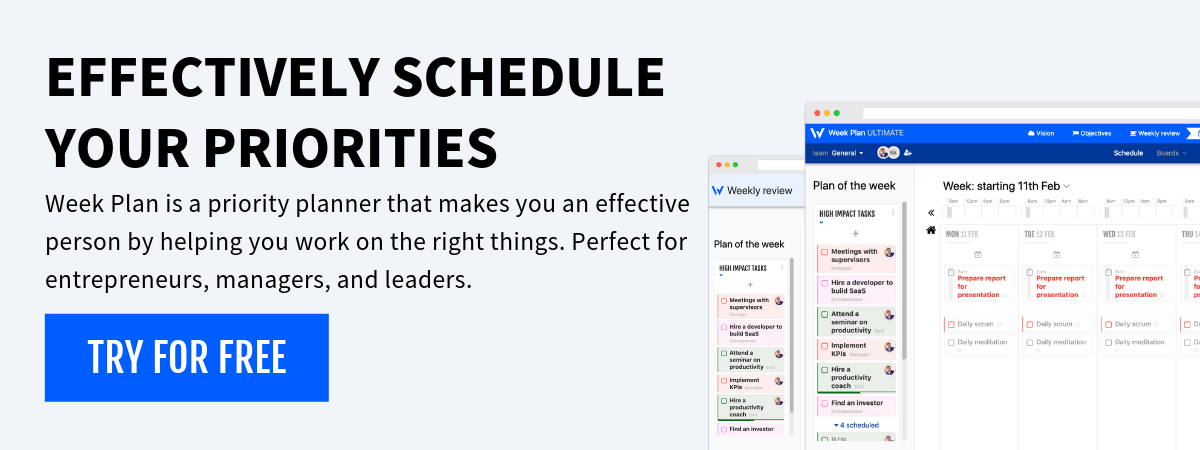
Week Plan is one of the most effective task management software which can also be helpful to organize your goals. Week Plan offers numerous services like goal planners, life planners, daily planners, and many more. It is also the best tool for goal-setting and tracking time over tasks and activities.
With the right approach, support, and careful planning, you can ensure that all new goals, past reflections, and future ambitions are successfully managed, letting you achieve goals, stay motivated, and focus on what truly matters in life and business.
More Posts
Top 10 Best Digital Goal Planners
![Decoding Top 10 Premier Digital Goal Planners]() Discover effective digital planners to help you stay on track and achieve your aspirations in 2025. Start planning your success today! In the ever-evolving digital era,...
11 Essential Elements of a Successful Partnership Meeting
A successful partnership meeting is a key strategic tool that enhances collaboration, drives decision-making, and reinforces shared objectives. In today's fast-paced professional environment, Zippia research indicates that an average worker spends 31 hours...
9 Innovative Ways of Working to Boost Productivity
Productivity is more than just doing tasks. It's about how well and efficiently employees help reach company goals. This makes the company stronger and more profitable. Finding new ways to make employees more...
Habit 7 of Highly Effective People: Sharpen the Saw
Summary Of Habit 7 of 7 Habits - Self Renewal Have you ever heard of the term ‘Sharpen the Saw’? What does it refer to? It means enhancing and preserving the greatest asset...